
Owners and operators face tightening Building Performance Standards (BPS), local decarbonization mandates, and corporate net zero commitments, accelerating the need to act on electrification as a key pillar of building decarbonization. Yet electrification for existing buildings has often been framed as expensive and disruptive, prompting owners and operators to ask: does electrification of existing buildings make good business sense?
IS ELECTRIFICATION FINANCIALLY FEASIBLE FOR EXISTING BUILDINGS? (ANSWERED HONESTLY)
Without an integrated approach, electrification doesn’t always pay back. But when integrated with smart capital replacement planning, it often does.
Electrification works best when it’s embedded into normal capital replacement cycles, not layered on top of them, and executed through thoughtful replacement strategies. This shift changes everything. When executed well, owners can achieve strong ROI through improved system efficiency, reduced operating costs, and enhanced long-term operational resilience, all without unnecessary disruption.
HOW SHOULD OWNERS AND OPERATORS PLAN FOR ELECTRIFICATION?
As owners and operators consider how to best invest in their next upgrade, consider these strategic steps:
-
- Anticipate equipment end-of-life events and integrate electrification into long-range capital planning.
- Evaluate electrification options early through structured feasibility assessments before defaulting to like-for-like replacements.
- Engineer solutions strategically to minimize or avoid costly infrastructure upgrades and unnecessary capital disruption.
How does this play out in practice? Let’s look at a real-world case study.
A REAL-WORLD CASE STUDY: FROM FEASIBILITY TO IMPLEMENTATION
A global software firm committed to a net zero emissions goal by 2040 across its real estate portfolio. One of their campuses, located in San Diego, California, consists of four buildings totaling approximately 480,000 square feet. The campus has rooftop AC units for space cooling and gas-fired boilers for space heating. It also provides culinary services, and the commercial kitchen is served by a gas-fired domestic hot water system and a kitchen makeup air system. At the time of the electrification assessment, the aged eight rooftop units were at end of life and required near-term capital replacement.
That raised a pivotal question: If the systems needed replacement within their planned capital cycle, should this be a like-for-like replacement or a strategic investment that accelerates the path to net zero?
Recognizing that removing on-site combustion is fundamental to achieving the client’s building decarbonization goals, Stok initiated a comprehensive assessment of what full electrification would take.
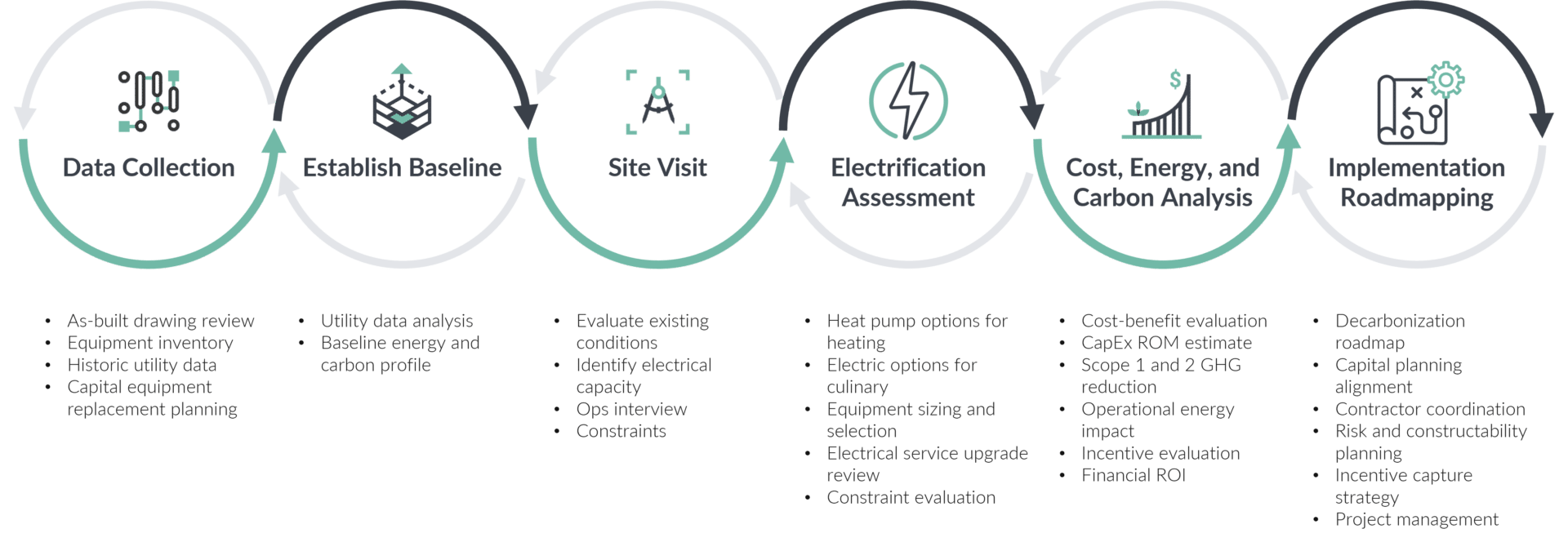
We evaluated practical electrification pathways to all sources of on-site combustion through on-site assessments. Rather than treating decarbonization as a standalone initiative, we assessed each pathway against the equipment’s remaining useful life and planned capital replacement cycles. For each scenario, we analyzed budget alignment, operational savings, and carbon reduction potential, so decarbonization advanced in step with asset lifecycle events.
Rather than pursuing a like-for-like cooling-only rooftop unit replacement, the client leveraged Stok’s electrification feasibility study and technical advisory to implement an innovative custom all-electric integrated heat pump system that not only provides space cooling, but also generates sufficient hot water to serve multiple heating end uses: VAV reheat coils, kitchen makeup air, and domestic hot water heating, all from a single platform.
One system, many wins.
AVOIDING THE ELECTRICAL UPGRADE ASSUMPTION
A like-for-like replacement of gas-fired boilers with electric options would potentially have increased the electrical load enough to require a major service upgrade; however, electrification does not automatically mean an electrical penalty if the system is engineered intelligently.
“By using a variable configuration heat-pump architecture and carefully managing load diversity, the system enabled retirement of the existing gas boilers without adding a single amp to the building’s connected electrical load with much improved system efficiency. That’s a huge advantage for decarbonizing existing buildings.”
—Mike Sabbaghian, Applied Equipment Manager at US Air Conditioning, who provided the custom rooftop heat pump systems for this project.
OPERATIONAL COST AND CARBON IMPACT
Electrification is a carbon strategy and a long-term operating cost and risk management strategy. Modern heat pump systems operate at 3-5x the efficiency of gas boilers, allowing one integrated rooftop platform to replace multiple legacy systems with significant operating energy cost savings while eliminating on-site combustion. In our case study, the annual energy cost savings are estimated at $180,000 along with 100% greenhouse gas (GHG) emission reduction.
| Live Electrification Example | |
|---|---|
| Annual Energy Cost Savings (est.) | $180,000/yr |
| GHG Emission Reduction | 100% |
| GHG Emission Avoided | 10,525 Metric Ton |
| Zero Emission? | Yes |
The above savings shown reflect only operational energy costs and exclude avoided maintenance costs such as boiler service, flue upkeep, gas safety compliance, and combustion tuning, all of which provide additional, ongoing savings. That’s before factoring in natural gas price escalation—gas prices paid by U.S. consumers rose 12% in 2025, two times faster than electricity and four times as fast as overall inflation, according to the U.S. Bureau of Labor Statistics.
UNDERSTANDING THE INCREMENTAL CAPITAL PREMIUM
Importantly, ROI should be calculated based on the “incremental” capital premium above a like-for-like replacement, given that the equipment required replacement anyway, rather than the full project cost. This methodology more appropriately reflects the true financial impact of the electrification decision.
The custom rooftop units in this example were designed to reuse existing power connections and curbs, minimizing structural work and field labor. Installation was scheduled for a single weekend, offering a quick turnaround with no disruption to operations.
“By strategically integrating electrification into the planned replacement cycle and customizing the units to minimize construction impacts, the project required only an approximate 20% premium over a traditional like-for-like system, yet it achieved the full decarbonization goal while avoiding a separate, disruptive, and capital-intensive retrofit in the future, delivering long-term lifecycle value.”
—Patrick Willette, Vice President of Construction, RAM Construction
Notably, this capital premium is substantially lower than pursuing electrification later as a standalone retrofit, where replacing gas-fired equipment individually would likely require additional infrastructure upgrades, extended downtime, and significantly higher overall investment.
ELECTRIFICATION AS A CAPITAL STRATEGY
As this example demonstrates, electrification doesn’t have to be disruptive, excessively expensive, or costly to operate. For existing buildings, it delivers the greatest value when treated as a capital replacement strategy embedded within planned lifecycle events. Strategic decarbonization planning helps owners act early, align with capital cycles, and make sound financial decisions.
At Stok, we approach portfolio-level roadmaps and asset-level assessment and implementation with this lens, aligning carbon reduction with business reality so owners can move toward long-term value. Talk to our team and read our 5 tips to electrify to get started.