We’re proud to share Stok’s second annual impact report!
Transparent ESG reporting enhances stakeholder trust while driving action. A recent study even found that sustainability report readers read sustainability disclosures as much as financial disclosures and interact more with sustainability information. As a small business and consultants who guide organizations through ESG program development and implementation, reporting is one part of a much bigger question: how can a strong ESG program protect and create value for our business while helping us deliver greater value for our clients and stakeholders?
WHAT’S THE VALUE OF AN ESG STRATEGY AND ROADMAP?
Building strategy, systems, and accountability into an ESG roadmap makes reporting possible and enables organizations to use what they learn to make smarter investments for greater impact. An ESG strategy and roadmap create value by:
- Aligning sustainability efforts with strategic business priorities.
- Streamlining resources to the most material topics driving business and stakeholder value.
- Developing a baseline of existing ESG performance to track future progress and develop the business case and ROI narrative.
- Streamlining KPIs to reduce data tracking efforts to only the most crucial and value-add information.
- Developing clear and consistent reporting metrics to communicate to all parties responsible for tracking and reporting.
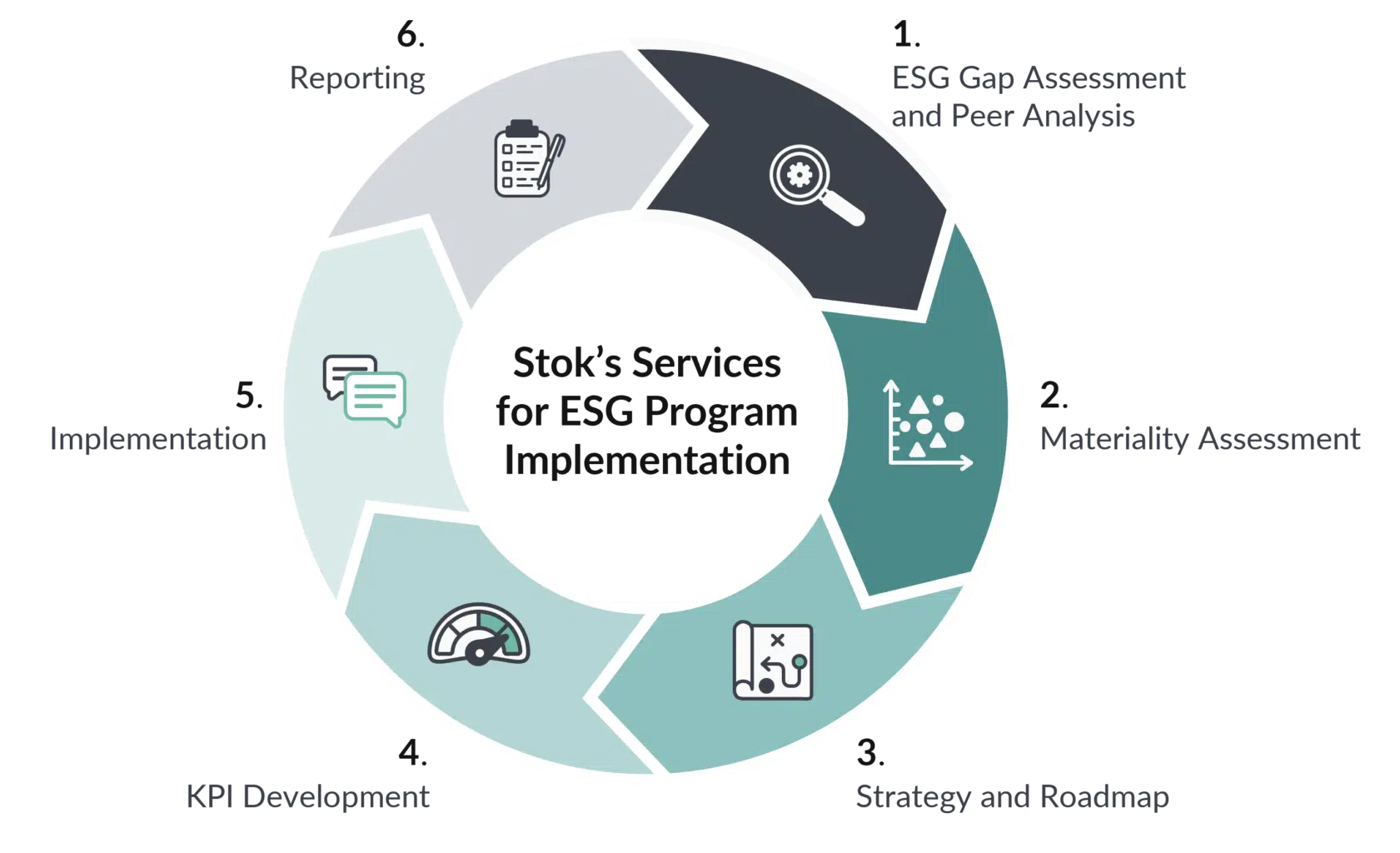
Stok’s services for ESG program implementation. Repeat steps one through four every three to five years.
STOK’S LESSONS LEARNED ALONG OUR ESG JOURNEY
Listen to stakeholders to focus on what matters most.
To establish a strong foundation for our ESG strategy, we conducted a competitor analysis, evaluated our alignment with leading ESG frameworks, and completed a materiality assessment. We conducted extensive stakeholder interviews and engagement activities across the business to gather diverse perspectives and better understand stakeholder expectations. These insights helped align our priorities with the issues that matter most to our stakeholders, our operations, and our long-term success.
Learn more about our materiality assessment results.
Use frameworks to set targets, shape strategy, and meet evolving stakeholder expectations.
Stok’s early ESG initiatives were largely shaped by Stok’s strategic vision, reporting through our B Corp certification and Just label, and an embodiment of our core value to demand better. As we began to mature our ESG strategy, we selected EcoVadis as a framework to assess our current state, identify priorities alongside our materiality assessment, benchmark performance, and measure progress over time.
One driver of our decision to use EcoVadis was a request by a major client partner. Additionally, from our firsthand experience with navigating clients through the framework, we consider it a top global supplier sustainability rating method that can provide our clients and partners with an independent, credible assessment of our performance. An EcoVadis ranking helps strengthen our market position as a sustainability consultant whose clients use impact reporting to evaluate suppliers in alignment with their own sustainability commitments.
We began with a gap assessment with extensive cross-functional team engagement. Our gap assessment provided actionable recommendations that informed our ESG roadmap, while stakeholder engagement helped us identify and connect initiatives already underway across the organization. By documenting existing practices and accomplishments, we strengthened our ESG story and developed our 2025 Impact Report. The report provides a comprehensive view of our progress, supports our upcoming EcoVadis submission, and helps us meet evolving stakeholder expectations. More importantly, the process demonstrated how a framework can go beyond a reporting exercise to serve as a catalyst for alignment, action, and continuous improvement.
Turn ambition into action with a roadmap.
A roadmap acts as a planning tool that turns long-term goals into actionable initiatives across the organization. By engaging with business units throughout the planning process, teams can identify opportunities, align priorities, and verify that ESG initiatives are incorporated into annual work plans and budgets to create an actionable ESG roadmap. During our most recent gap assessment, we identified several opportunities related to strengthening our employee health and safety practices, as well as improving our sustainable procurement approach. We worked with the responsible team members to sort opportunities by level of effort: quick wins we could implement immediately, and larger initiatives to build into next year’s budget and planning.
The roadmap also helps us understand the resources, expertise, and collaboration needed to successfully implement initiatives. By aligning these priorities with business objectives, we create opportunities for team members across the organization to contribute to, build ownership within, and continuously improve our program.
Focus on standardized, comparable metrics that matter.
EcoVadis helps us measure and track progress on our sustainability journey through a standardized assessment framework and industry-specific benchmarking. The assessment provides a clear view of our performance relative to peers, helping us identify strengths and opportunities for improvement while prioritizing the actions that can drive the greatest impact. It also helps us stay informed about evolving stakeholder expectations and emerging sustainability trends within our industry, keeping our strategy focused, relevant, and aligned with what matters most to our clients and stakeholders rather than trying to track and report on everything.
Share progress through reporting.
Our materiality assessment and EcoVadis gap assessment helped shape the content and focus of our impact report. Together, they informed the topics most important to our stakeholders and our business, enabling us to tell a more meaningful and strategic story about who we are, our culture, and our commitment to creating a radically better world for all.
MAKING LASTING CHANGE WITH STOK IMPACT
Inside Stok’s 2025 Impact Report, you’ll discover some of our proudest recent achievements—aligned with the priorities of Stok team members and our external stakeholders—including:
2025 Impact by the Numbers
emissions from the 2023 baseline*
projects investments
*Before application of our market-based mechanisms, including renewable energy certificates (RECs) and carbon credits.
You’ll learn about the goals, programs, and initiatives behind the numbers, like Stok’s science-based targets validated by the Science Based Targets initiative (SBTi); our fourth annual greenhouse gas inventory and first decarb audit; an expanded Pro Bono Professional Services program and reimagined charitable giving programs; newly launched decarbonization and data center task forces to strengthen the value we deliver to clients; and evolved core values to guide us as we strive toward our commitment to a radically better world for all.
READ THE REPORT
Our goal for impact at Stok includes remaining committed to an ESG program that is credible, measurable, continuously improving, and aligned with our purpose to boldly catalyze an environmentally restorative and socially equitable world. We’ve been proud to undertake the same journey toward meaningful, measured impact that we help our clients navigate. Up next, we’re excited to submit our first EcoVadis submission in 2026 and use the insights to strengthen our strategic roadmap and shape investments in our program.
Stok’s latest impact report shares our continued progress toward a radically better world for all. Read the full Stok 2025 Impact Report.
Explore Stok’s 2025 Impact Report