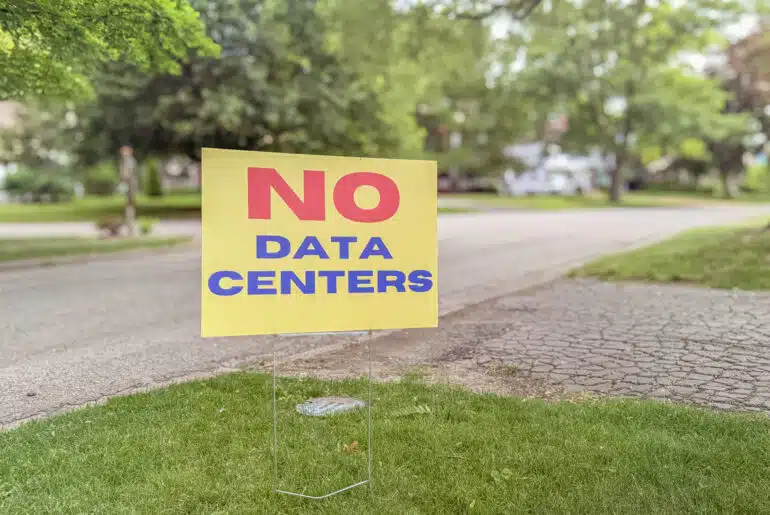
Data center developers face a growing challenge: no one wants a data center in their backyard.
Whether it’s concerns about noise pollution, the risk to local water resources, or that data centers produce a significant amount of greenhouse gas emissions at a time when climate change impacts have become more visible and urgent, communities are increasingly pushing back on data center construction:
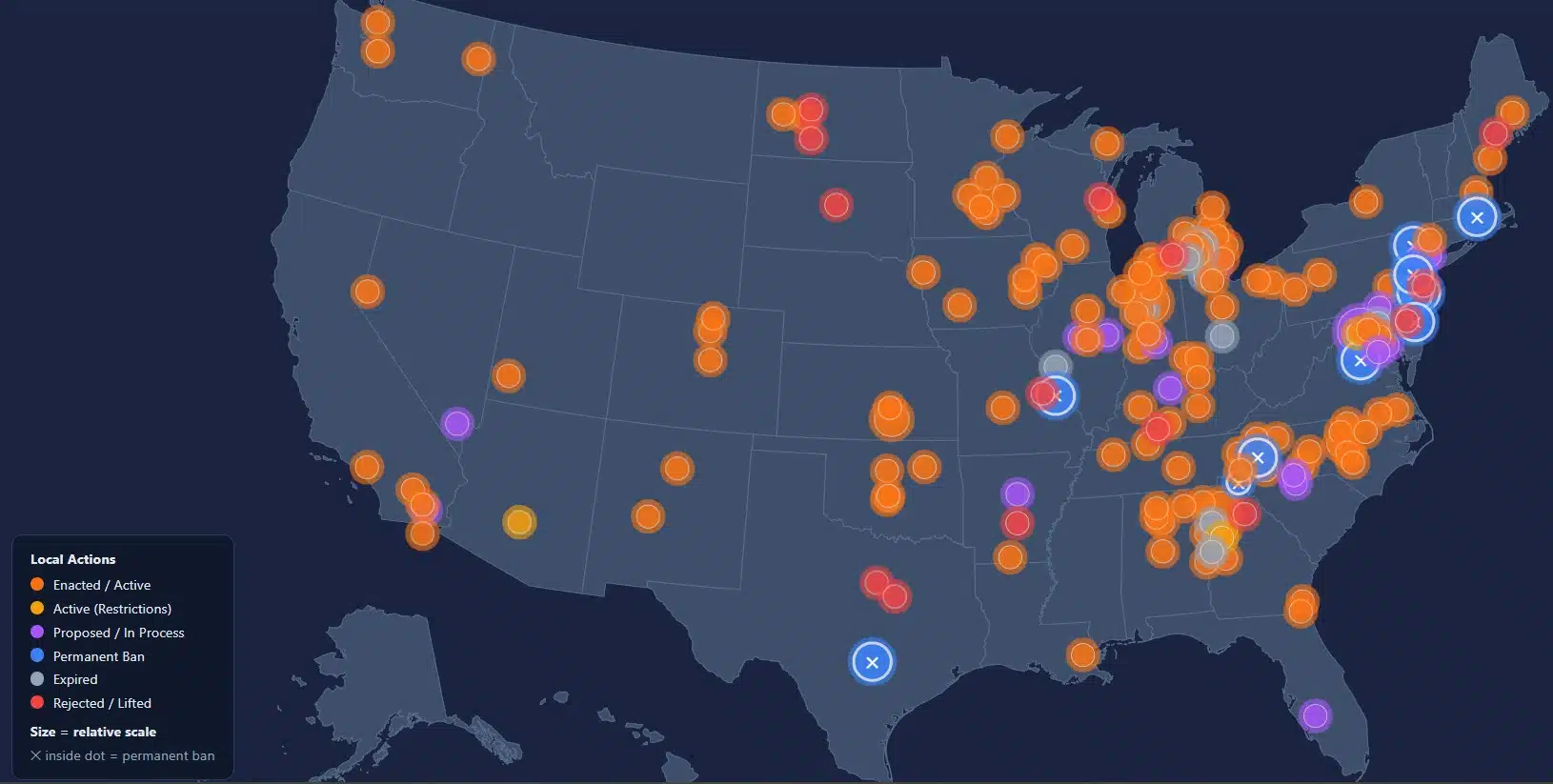
- As of mid-2026, “community opposition to AI data centers has disrupted over $228 billion in U.S. infrastructure projects, blocking $18 billion outright and delaying a further $130 billion in Q1 2026 alone.”
- There are currently 188 opposition groups operating across 49 U.S. states, which have garnered local lawmaker support via restrictions, moratoriums, and outright bans.
(Note: We won’t get into another major area of community pushback here, the impact of data centers on utility rates, which deserves its own focused analysis given its complexity.)
This pushback signals that stakeholders are concerned about data center construction and operations in their communities, and it’s something hyperscalers and data center developers need to address if they want to get their projects built quicker (or at all), enabling them to move revenue-generating projects toward completion faster rather than sitting idle in permitting.
WHAT CAN HYPERSCALERS AND DEVELOPERS DO TO MOVE PROJECTS FORWARD?
In the face of this license to operate issue, what hyperscalers and developers can do is listen to local community concerns, transparently communicate the real impact of their project, and take focused steps to minimize their environmental impacts and create benefits over time for the communities in which they operate.
This requires early engagement of a sustainability team. Many decisions made early in a data center project are hard to reverse and will last the life of the project, so they’re important to get right from the start. Yet sustainability teams are often not included in permitting conversations, which can create friction when sustainability is introduced late or treated as a separate workstream. When integrated early, sustainability teams support data center providers with the strategic and technical expertise needed for speed, confidence, and scale.
HOW CAN SUSTAINABILITY BENEFIT DATA CENTER PROJECTS?
#1: Build trust with community to gain approval and speed up permitting
Though each project is unique and developers should localize community engagement to address specific concerns, they can also leverage third-party frameworks to objectively convey verified impacts to get local community buy-in. Third party standards are an excellent way to easily communicate to the public—who are likely not deeply ingrained in the nuances of sustainability—that a data center is focused on minimizing its environmental impact. Early strategic and technical advisory can help clients make defensible trade-offs between sustainability goals and operational realities using existing frameworks like Green Globes and LEED as a starting place and customizing as needed.
One of Stok’s clients, a global developer of hyperscale data center campuses, has committed to LEED certifying all their projects. This commitment is directly aligned to the company’s desire to demonstrate to local community members its approach to responsible design, construction, and operations.
#2: Translate corporate goals into action
We hear from many clients with sustainability programs that they aren’t sure how to translate their corporate climate commitments and sustainability goals through their basis of design (BOD). This gap between strategy and implementation is common across industries. Many of our clients have many in-flight projects and it can be hard to impact each one individually. By translating their sustainability goals into a BOD, the client knows that each project, whether their sustainability team touches it or not, will meaningfully support the achievement of their climate and sustainability goals.
From there, teams can rely on subject matter expert advisory to translate technical impacts in terms that resonate with stakeholders. With growing community pushback to data centers and the wide range of stakeholders sustainability leaders must communicate with—not just investors, but developers, engineering teams, operators, regulators, and communities—this is particularly important for data center projects.
For example, Stok developed a targeted certification approach that adapts a Fortune 50 client’s comprehensive and complex Data Center Design and Construction Sustainability Standard to meet LEED for Data Centers Gold certification across 16 data center projects nationwide with more in-flight. In addition to the 50% energy use reduction, 98% water use reduction, and 92% diversion of construction waste realized across projects, the translation of corporate standards into individual project certification helped the client move toward its climate goals via framework-aligned asset-level implementation.
#3: Pilot projects to scale effectively
Data center performance is critical, and anything that could negatively impact it or add complexity will be rightfully scrutinized. At the same time, hyperscalers and data center developers are rapidly introducing innovations in design and construction—like Meta’s leadership in deploying low embodied carbon concrete—to minimize their environmental impact, increase resilience, and garner approval—for many, at scale. This is where pilot projects come into play.
Especially with the growing impact area of embodied carbon, we’ve helped clients run low-carbon concrete pilot projects to stress test them across different regions before deploying the relatively new approach across portfolios. This “slow down to speed up” approach helped examine and eliminate risks with the deployment of a new, critical material, then allowed the client to scale the approach across all new data center projects, enabling sustainability success at speed and scale.
DATA CENTER SUSTAINABILITY IN PRACTICE
Every project has different priorities and best-fit approaches to sustainability. That said, if you’re ready to get moving, here are some key initiatives to consider that may have meaningful impact on your project:
Closed-loop cooling
Closed-loop cooling reduces project water consumption and now has less of an energy trade-off thanks to direct-to-chip (D2C) cooling technology. The simple fact that a closed-loop cooled data center uses about the same amount of water as a restaurant can considerably support faster permit approval in drought-sensitive jurisdictions, which is especially important given the public perception of water usage in data centers.
Alongside credible water restoration efforts, developers can then commit to being water positive in their operations, as many hyperscalers have. Meta’s Water Positive commitment, for example, is a story of a hyperscaler responding to community pushback by treating water as a shared resource. Meta is now improving data center water efficiency, investing in local water restoration and conservation projects, and publicly reporting its water use as part of its sustainability efforts, ultimately targeting to become water positive by 2030.
Behind-the-meter energy
Energy infrastructure in the U.S. can’t scale fast enough to meet data center demand, pushing many toward behind-the-meter solutions. That said, these solutions—often natural gas turbines—pose a significant reputational risk for the data center industry, as many hyperscalers and cloud providers have set ambitious corporate net zero commitments. Not only does behind-the-meter natural gas work against net zero commitments, but the turbines can also be a major sticking point with local communities given the noise and air pollution they contribute to. xAI, for example, has received intense pushback for the use of behind-the-meter natural gas turbines for its Colossus 1 and 2 projects, causing project stalls.
Fortunately, we’ve seen successful examples of solar and battery storage being built to directly power data centers behind-the-meter or new large-scale developments in grid financed by hyperscalers or developers, like Google’s largest-ever solar and battery storage project. These need to become the norm rather than the exception.
Embodied carbon
This is an area where data centers are changing the game and should be highlighted. The industry’s buying power has led to the development of low-carbon material technology specifically in the concrete space that will truly revolutionize how we decarbonize our world. For example, Amazon has moved from low-carbon concrete pilots to scaling it steadily across its global portfolio. This focus on low-carbon innovation can also differentiate projects early before opposition grows.
THE BUSINESS CASE FOR SUSTAINABILITY IN DATA CENTERS
When you think of making the business case for sustainability, the first thing that often comes to mind is having to show the financial benefit and ROI of a sustainability intervention. With data centers, sustainability is fast becoming a determining factor in whether data center projects get built quickly, or at all. That means that ambitious and transparently-communicated climate and sustainability goals can be one of the deciding factors in whether a project makes money at all, and that’s a strong business case.
When sustainability expertise helps inform credible sustainable design, construction, and operations guidelines, and supports their implementation across portfolios, organizations can move from reacting to community pushback to proactively earning trust while improving performance, turning environmental performance into a competitive advantage. The data centers that scale fastest in this next chapter of AI infrastructure will be the ones that treat sustainability as the foundation for speed and long-term success.