The next generation of green building certification is here. Released in April 2025, LEED v5 introduces powerful updates that shift the industry toward carbon reduction, energy performance, and electrification. While teams have until June 30, 2027, to register under LEED v4/4.1, the biggest shift for commissioning in v5—earlier commissioning engagement—requires owners, occupiers, and AEC teams to rethink project timelines now.
LEED v5 brings with it the biggest changes to commissioning (Cx) since the certification’s inception, elevating its scope, rigor, and enforcement to drive better building performance and quality outcomes. Preparing for these changes from now not only avoids future commissioning agent (CxA) onboarding scrambles but also unlocks immediate benefits of earlier commissioning engagement regardless of certification requirements.
Here’s what owners and design teams need to know about commissioning in LEED v5, and how to take advantage of earlier, deeper commissioning involvement throughout your project.
#1: COMMISSIONING ENGAGEMENT STARTS EARLIER IN DESIGN
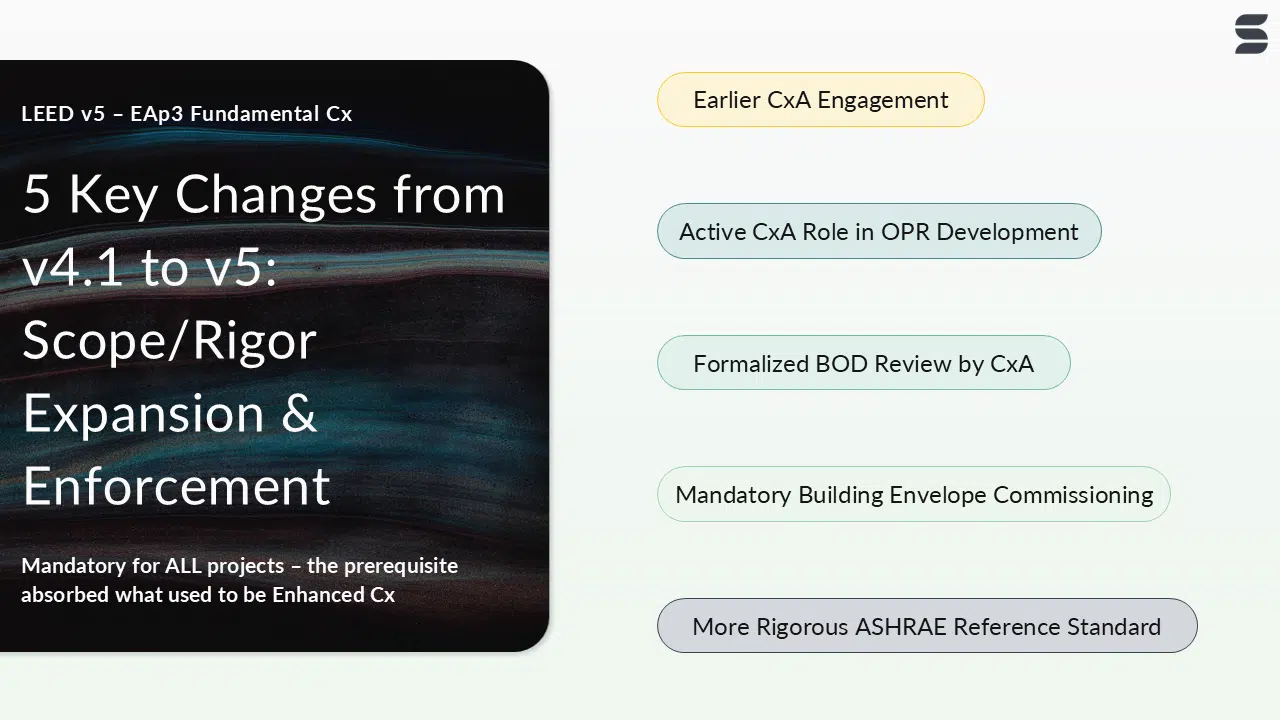
Perhaps the most consequential change in LEED v5: the CxA must be engaged during schematic design or earlier. This shifts commissioning upstream, requiring the CxA to support the development of the Owner’s Project Requirements (OPR), review the Basis of Design (BOD), develop a commissioning plan, and conduct design reviews before design development. Where in earlier versions of LEED these tasks were part of the enhanced commissioning credit, they are now required under the fundamental commissioning prerequisite.
This new timing and sequencing bring valuable alignment and rigor early in the design process:
-
- OPR and BOD involvement aligns design with owner’s goals: Early CxA engagement helps define and document owner priorities, then verify design decisions stay aligned and reduce rework later.
- Design reviews reduce risk and change orders: Commissioning-focused design reviews identify OPR and BOD misalignment and energy efficiency opportunities early, reducing errors, delays, and budget impacts down the line.
In both cases, the OPR and design reviews deliver the most value when developed early enough to shape design decisions rather than retroactively documenting them. LEED v5 reinforces this shift through earlier commissioning engagement.
Beyond earlier engagement, LEED v5 also expands what commissioning includes, most notably by bringing the building envelope into the required scope.
#2: BUILDING ENVELOPE COMMISSIONING IS NOW REQUIRED
The building envelope is one of the few building systems that owners expect to only buy once. It should last the whole life of the building, so design and construction are your one chance to get it right.
LEED v5 recognizes this by requiring building envelope commissioning for all projects (it was previously part of enhanced commissioning and often only done for specific project types). This means your CxA now tests both the MEP systems and the building enclosure to verify performance and functionality. This new fundamental commissioning requirement marks a shift from building envelope commissioning as a special case toward building envelope commissioning as a standard for every project. Commissioning the envelope brings advantages to every project through:
-
- Improved energy efficiency and comfort: Verifies the building enclosure performs as designed, optimizing energy performance, lowering operating costs, and improving indoor conditions.
- Moisture control: Confirms the enclosure prevents water intrusion and associated impacts to energy efficiency.
- Performance insight: Provides energy performance data for the building envelope to identify potential energy reduction opportunities.
- Reduced post-construction risk: Identifies potential façade and enclosure issues early, minimizing costly repairs and enhancing long-term value.
In our experience, many building enclosure issues stem from installation errors and poorly coordinated system transitions. Early CxA involvement enables teams to identify and resolve these risks before façade design is finalized, avoiding costly fixes during construction.
In addition to expanding scope, LEED v5 also raises the bar on how projects demonstrate performance by shifting from flexible guidance to mandatory standards.
#3: A HIGHER ENERGY PERFORMANCE BASELINE
Under LEED v5, projects must comply with newer versions of ASHRAE 90.1: ASHRAE 90.1-2019 for projects registered before January 1, 2028, and ASHRAE 90.1-2022 for projects registered on or after January 1, 2028. While ASHRAE 90.1 was already required under previous versions of LEED, LEED v5 raises the baseline by adopting more stringent versions of the standard. This supports LEED v5’s broader emphasis on energy efficiency, decarbonization, operational performance, and long-term building outcomes. In California, projects complying with the 2025 Energy Code are already moving toward earlier commissioning engagement and greater enclosure-related requirements, making the transition to LEED v5 less disruptive.
Aligning design with these standards helps:
-
- Improve energy performance and system reliability.
- Reduce energy consumption and operating costs.
- Support proper controls integration and maintainability.
- Extend equipment life through more efficient operation.
For project teams, this means fewer interpretation gaps, clearer performance expectations, and greater assurance that building systems will deliver the intended outcomes. LEED v5 further reinforces this approach by emphasizing ongoing monitoring, measurement, and long-term operational performance.
#4: MONITORING-BASED COMMISSIONING LOOKS LONG-TERM
LEED v5 encourages best practices for monitoring-based commissioning (MBCx), shifting it from a short-term check-in to a long-term operating practice. Both optional paths require at least three years of MBCx, compared to one year under LEED v4/4.1, reinforcing its role in verifying performance beyond initial setup and into stabilization and ongoing operations.
While this increases owner commitment, it also enables ongoing optimization of building performance, reducing energy use, improving occupant comfort, and extending equipment life. In addition to capturing multiple seasonal cycles, the longer duration improves confidence in results by allowing time to catch system drift or recurring issues and verify that subsequent changes make an impact and persist. It also allows time to embed operational best practices, account for staff turnover, and differentiate between operational inefficiencies and true capital needs, ultimately leading to more durable performance improvements and stronger long-term value.
KEY TAKEAWAYS FOR PROJECT TEAMS
LEED v5 fundamentally reshapes commissioning in exciting ways:
-
- More design influence: CxA engagement starts early enough in design to meaningfully influence decisions, while there’s still flexibility to explore system alternatives.
- Envelope is not optional: Building envelope commissioning is now required under fundamental commissioning.
- Increased rigor and accountability: There are more required activities and site visits, formal documentation requirements, and elevated standards-based compliance.
Together, these shifts drive more aligned design, reduced risk, and verified performance outcomes from day one through operations.
Ready to elevate your project with LEED v5? Learn what else teams should know about LEED v5’s energy overhaul, and reach out to our team to optimize commissioning from design through operations and unlock better building performance. Stok can help you navigate LEED v5 and leverage certification as a streamlined framework for scalable, high-impact sustainability.