AI infrastructure sustainability has become an energy conversation. LEED O+M’s structure is a useful corrective.
Top takeaways:
-
- LEED O+M scores across five categories. Energy is the hottest debated topic among them for data centers, but shouldn’t be the only one.
- Water: Most operators can’t produce twelve months of metered potable water data split between cooling and domestic use, which leaves them empty-handed for permit hearings.
- Waste: Procurement knows where decommissioned hardware goes; meanwhile, sustainability usually doesn’t. One financial services firm paid $35 million in penalties learning why that gap matters.
- Human experience: Raising setpoints saves 4-5% per degree and pushes contained hot aisles toward 47°C. Few operators have surveyed the technicians who work in them, and future OSHA regulations may require more attention here from operators.
- Transportation: Rural siting plus 24/7 shift rotations means location-scored transit credits can reward access the workforce structurally can’t use, and ultimately lead to poor public transit infrastructure investments.
AI data center conversations often focus on energy. Megawatts, grid interconnection queues, PPAs, nuclear restarts, carbon intensity. When consumption is growing roughly 15% per year, more than four times faster than every other sector combined, energy remains the right conversation to be having. It is just not the only one.
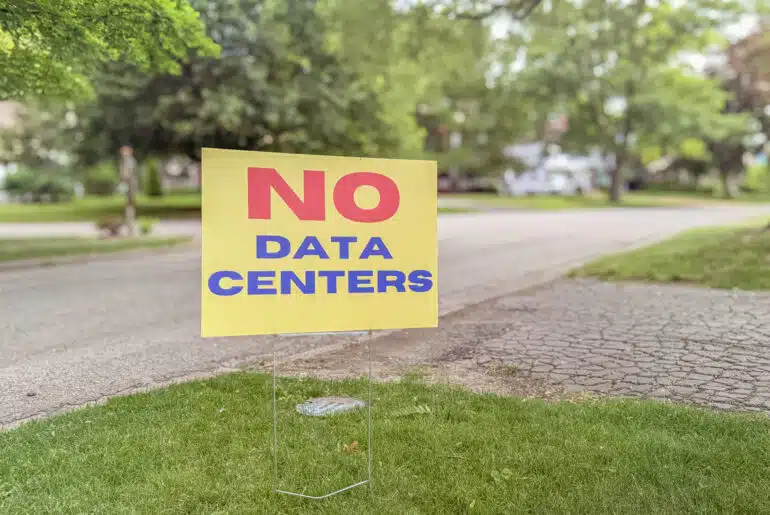
Stok has argued that sustainability is rapidly becoming a determinant on whether data centers get approved. This is about not only approval, but also extends the conversation to ask what happens after they are built.
LEED O+M’s (Leadership in Energy and Environmental Design, Operations & Maintenance) structure—across energy, waste, water, human experience, and transportation topics—provides a lens not only as a certification target, but also a diagnostic, to understand what a well-run facility should also be able to answer. A facility that can answer these questions also moves faster through entitlements, walks into community hearings with data, survives diligence, and holds onto technicians it can’t easily replace.
The framework version matters less than the discipline: you cannot claim a well-run building on energy alone. The five-category structure is the Arc Performance Score, which underpins the v4.1 O+M performance path and also means asset managers cannot generate a Performance Score by excelling at one and ignoring the rest. LEED v5 O+M reorganizes into conventional credit categories, but the same four non-energy domains persist—an operator needs water and waste reduction performance, a human impact assessment prerequisite, and a transportation survey option.
WATER: HOW MUCH WATER DOES A DATA CENTER ACTUALLY USE?
Having dominated community conversations, and deservedly so, water is a primary concern for data centers. In LEED O+M, Arc’s water category requires a full year of potable water data to produce a score at all.
The measurement gap is the story. At a moment when siting decisions in water-stressed regions are becoming live permitting and community-relations fights, operators report energy consistently and water inconsistently. Skip the WUE (Water Usage Effectiveness) benchmark and ask something more revealing: can you produce twelve months of metered potable water data, broken out by cooling versus domestic use? A surprising number of facilities can’t. Inability to produce metered, disaggregated water data becomes evident the moment you walk into a permitting hearing empty-handed.
To produce even more powerful data, convert your annual withdrawal into units the hearing will use, such as share of the utility’s average daily production, or household equivalent. It’ll land more clearly to your audience what exactly your facility’s water impact is and how it compares to others.
WASTE: WHERE DOES DECOMMISSIONED DATA CENTER HARDWARE GO?
This is the most overlooked aspect of the sector, and it’s about to get worse.
In most buildings, construction ends and operations begin. However, in a data center, construction and operations live simultaneously because operators must keep rebuilding the inside of a live facility. AI buildouts are pulling chips years before depreciation schedules the industry was built around said they’d be pulled, and each round sends racks of equipment containing copper, gold, palladium, neodymium, and recoverable value.
Where does it go? The honest answer at most organizations is that procurement knows and sustainability doesn’t. Data destruction requirements push toward physical shredding, which forecloses reuse and destroys resale value. IT asset disposition (ITAD) vendors vary enormously in what they actually do downstream. Chain-of-custody documentation is frequently thin past the first handoff, and there’s liability for your company if the devices end up somewhere they shouldn’t. One financial services provider saved about $100,000 switching decommissioning vendors and then paid $35 million in regulatory penalties after thousands of its data center drives were resold with customer data still on them.
O+M’s framework asks for ongoing purchasing and waste tracking as a condition of certification and forces the question into the open. The diagnostic version: name your ITAD vendor, confirm whether they hold R2v3 or e-Stewards certification. While that isn’t a LEED requirement, it supports settlement reports and produces documentation of where last year’s decommissioned assets went. If that takes more than a week to answer, that’s the finding.
HUMAN EXPERIENCE: WHAT ARE THE EMPLOYEE CONCERNS FOR AI DATA CENTER WORKERS?
The freshest and most uncomfortable of the four, because it puts efficiency and worker conditions in direct tension. Skilled data center technicians are a genuine constraint on how fast this sector can build. Treating their working environment as a measured variable rather than a residual is both the decent thing and, increasingly, an operational necessity. The diagnostic question: have you ever surveyed your operations staff about their working conditions? Most facilities never have.
Arc’s human experience category is built on occupant satisfaction surveys plus indoor air quality measurement (e.g. carbon dioxide and total volatile organic compounds). Applied to a data center, it points at the technicians who actually work in these buildings: loud, windowless, thermally extreme environments with battery rooms and periodic generator testing.
Here’s the tension. Raising cold aisle setpoints is a well-established efficiency lever—ENERGY STAR estimates 4 to 5 percent in cooling energy savings per degree Fahrenheit of setpoint increase. The hot aisle rises, however, in step with the setpoint, reaching 47°C in contained designs. At that level, Wet Bulb Globe Temperature (WBGT) thresholds allow only light work a quarter of the time. In cold aisle containment, that aisle is the floor. The industry’s answer often defaults to an argument: nobody’s stationed in a hot aisle, and you can open the containment when someone is. Plausible, untested against a four-hour break-fix, and nothing requires testing it yet—OSHA’s heat rule is still proposed, the national emphasis program lapsed in April, and no framework that scores a data center on efficiency asks what the efficiency cost anyone.
A WBGT reading taken during a real break-fix, not at design conditions, converts an industry assumption into a defensible record.
TRANSPORTATION: HOW DO DATA CENTER STAFF ACTUALLY GET TO WORK?
The smallest of the four, but not zero. Arc scores transportation from occupant survey data on travel mode, trip length, and frequency.
Data centers are frequently sited rurally, with staff working 24/7 shift rotations — which means overnight commutes at hours when transit doesn’t run, over long distances, in single-occupancy vehicles. The population is small enough that a survey can reach it completely, which is a luxury no multi-tenant office has. Small footprint, easy data, and it rounds out a picture that energy metrics alone don’t give so that you can make better planning decisions.
Ashburn station, for example, the western terminus of Metro’s Silver Line, sits in the middle of the densest concentration of data centers on the planet, yet only averages roughly a thousand riders a day against an original projection of over eleven thousand across it and neighboring Loudoun Gateway. Site a facility beside that platform and any location-scored credit would reward you for transit access its workforce structurally will not use. That’s a land premium bought to be near a transit line and a credit earned for something no one on shift can actually take.
Arc scores the commute that actually happens, surveyed from the people making it. That’s the most useful data.
WHAT’S NEXT?
The energy conversation is going to continue to dominate headlines, and for valid reasons. But the operators who can answer questions about waste, water, human experience, and transportation will find the answers useful in rooms they didn’t expect: a permitting hearing, a diligence call about decommissioned drives, or a future OSHA inspection about what the hot aisle actually reads.