
This year we’re diving deep into the business case for sustainability so you can invest wisely, clearly communicate impact, and bring others along on the journey.
Top takeaways:
-
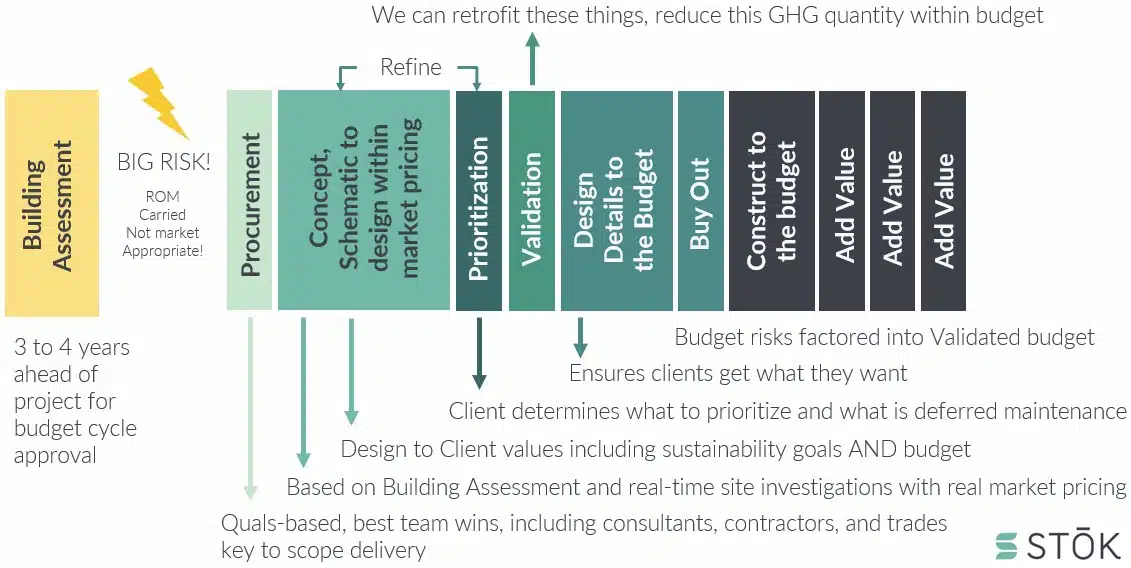
- Sustainability and energy conservation measures are often value engineered out of design-bid-build projects. Integrated project delivery (IPD) bakes client goals (including sustainability) into the conditions of satisfaction (COS), better allocating capital spend to achieve client decarbonization goals.
- The IPD process gets the right people into a project at the right time to determine how best to deliver decarbonization within budget and schedule and redirect non-value-add costs to desired value for the client.
As building owners and developers face growing pressure to decarbonize without increasing risk, cost, or complexity, traditional delivery models often fall short. We often hear from clients that on design-bid-build projects, they have to value engineer sustainability and energy conservation measures out of the project. Integrated project delivery (IPD) (a form of collaborative delivery) offers a solution, baking client goals into the conditions of satisfaction (COS), which can enable high-performance, low-carbon buildings within budget and schedule.
While 70% of conventional building projects are over budget and behind schedule, the average IPD and Lean construction process (the foundation of IPD) has resulted in projects that are 74% ahead of schedule, 64% greater profitability/reduced costs, 77% improved safety, and 80% greater customer satisfaction. IPD projects are more likely to finish ahead of schedule and under budget, and IPD delivers improvements in schedule, financial, environmental, communication, and change-management performance compared with non-IPD delivery. At the same time, IPD and other collaborative delivery models enable decarbonization by improving coordination, reducing rework, and aligning teams early around shared goals, which can help owners and developers meet their organizations’ climate goals within budget.
How can you leverage integrated project delivery to better allocate capital spend while achieving decarbonization? Let’s dive in, with examples from designers and builders as well as municipal owners.
HOW DOES INTEGRATED PROJECT DELIVERY BETTER ALLOCATE CAPITAL?
By going slow to go fast, IPD and other collaborative delivery approaches bring together all team members from the start of the project to mitigate risk for the project, which is owned by the whole team, delivering a higher quality, more sustainable project within budget and on schedule.
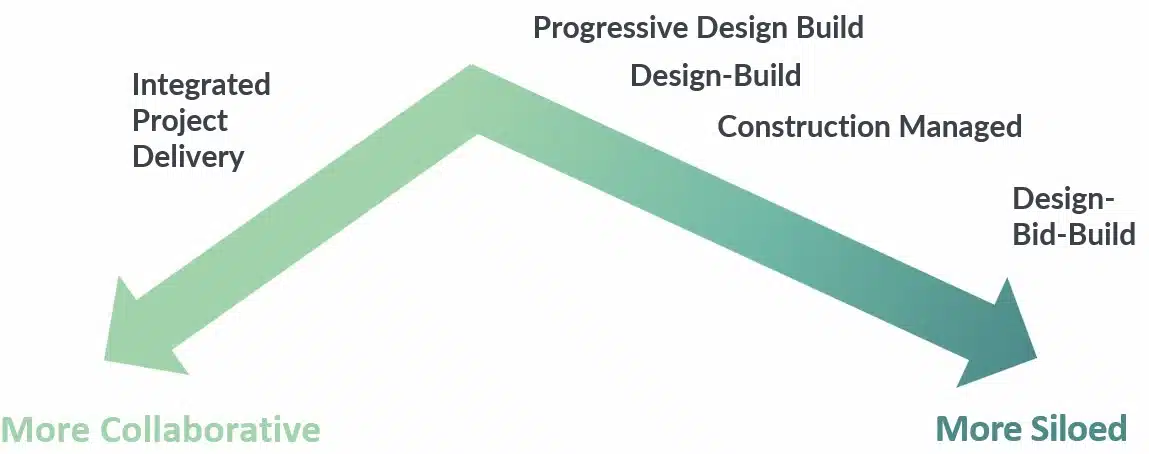
Early collaboration: IPD allows for early involvement of trade partners and client facility management among other key project partners.
Early decision-making: The IPD process takes advantage of the MacLeamy curve, removing process barriers by pushing as many changes as possible to the earliest phases of the project where they cost the least to implement.
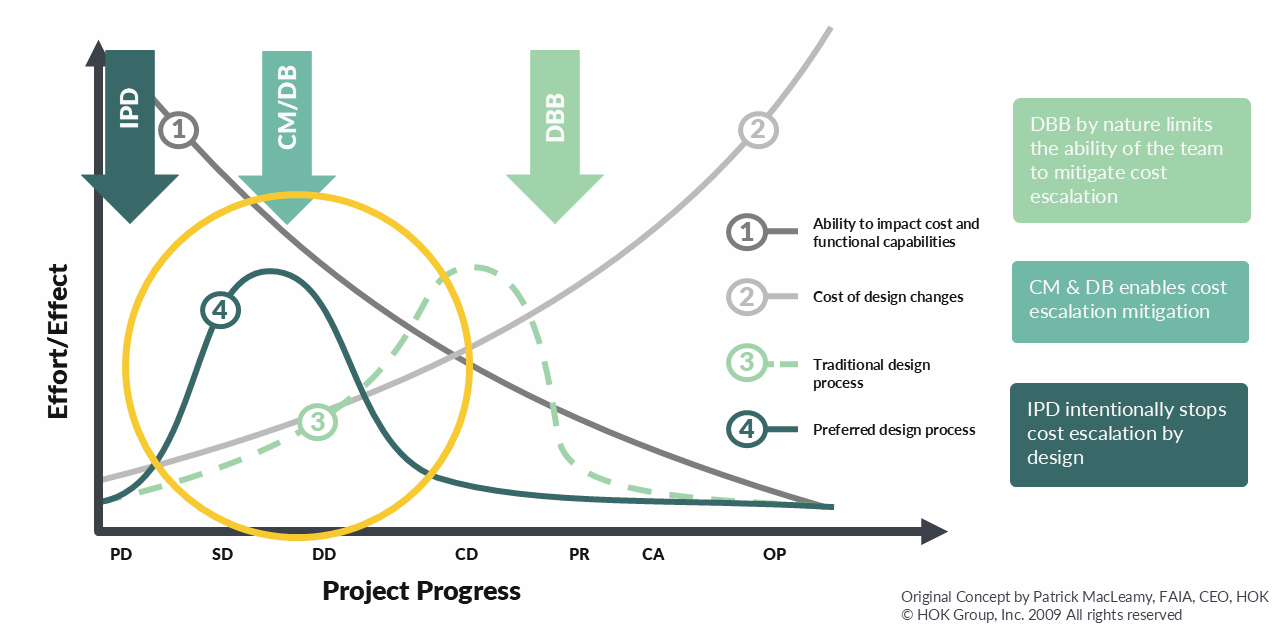
Fail fast: With IPD, all processes and people are focused on the Lean “fail fast” method to constrain spending to only the effort necessary to determine if a project is viable. Teams fail fast and multiple go-no-go checkpoints are part of the early process. This provides several off-ramps for the project to pause or stop if it’s clear the scope can’t be built for the budget available.
HOW DOES INTEGRATED PROJECT DELIVERY ENABLE DECARBONIZATION?
The early stages of the IPD process, including costing and scope iterations, are crucial for achieving ambitious sustainability goals such as net zero energy, zero carbon, and other innovative sustainability efforts for new builds and retrofits alike. Many examples demonstrate that early involvement in the planning process leads to more cost-effective and achievable outcomes.
Whole-system optimization
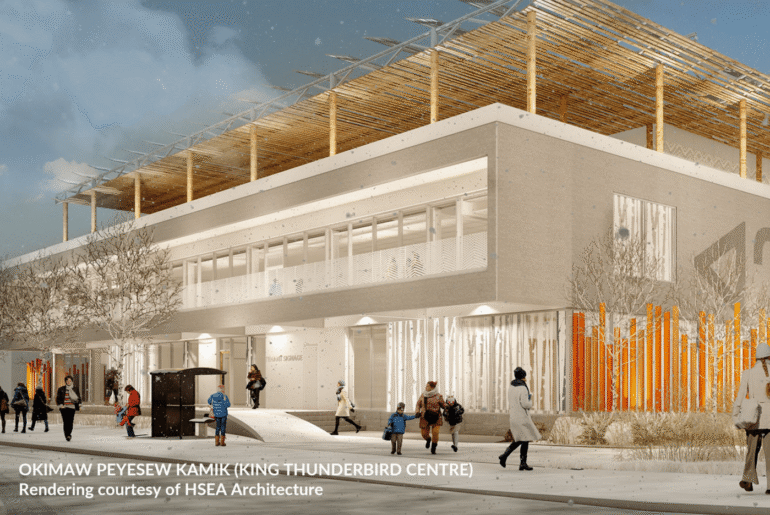
IPD and other collaborative project delivery methods shift value upstream, where it matters most for owners. On high-performance projects, teams that work together early can optimize across systems instead of designing in silos. For example, through early collaboration, the okimaw peyesew kamik (King Thunderbird Centre) team invested in a high-performance envelope that significantly reduced the size and cost of mechanical systems by lowering heating and cooling demand. The result was a smarter reallocation of capital that improves both first cost efficiency and long-term operating performance, all enabled by fast decisions through collaboration that allowed the project to achieve zero carbon on the client’s opening timeline.
Access to funding and incentives
On the Vernon Active Living Centre in British Columbia, IPD directly translated into new funding. By aligning early around decarbonization goals, the integrated project team was able to secure approximately $700,000 in combined utility grants from Fortis BC and BC Hydro. This required coordinated effort across the full team to identify opportunities, meet program requirements, and make decisions at the right moments in design. In traditional delivery, these opportunities are often missed because the right parties aren’t involved early enough; in this case, collaboration effectively brought new capital into the project.
Real-time cost and performance optimization
That same project demonstrates how integrated teams make better capital allocation decisions in real time. Using input from multiple trade partners alongside energy and carbon modeling, the team evaluated options ranging from envelope performance to heating systems and renewable energy. Each strategy was assessed against capital cost, operational savings, and emissions impact, allowing the team to quickly eliminate low-value options and focus investment where it delivered the greatest return. This kind of rapid, data-driven decision-making is difficult to achieve when cost, design, and performance are managed in silos through traditional delivery models—often relying on default data for decarbonization calculations, which can lead to oversizing systems and inflated costs, deterring teams from moving forward.[/vc_column_text][/vc_column][/vc_row]
“We can say from experience that the more collaborative a delivery method is with early trade involvement, the better the ability to reach the sustainability goals within budget.”
—Stephani Carter, President, Canada Region, Stok
Operational continuity
In existing municipal assets, the value of collaboration often shows up in risk mitigation and operational continuity. While IPD represents the most collaborative delivery model, other collaborative approaches can still deliver meaningful value. On four long-term care facilities for the Region of Peel, the project team used design-build delivery to develop a highly coordinated phasing strategy that allowed upgrades to proceed while meeting the client’s requirement to keep buildings fully occupied, never taking more than two beds offline at a time. By working closely with contractors and operators, the team sequenced system replacements, prioritized high-impact investments, and planned for future electrification where immediate upgrades weren’t feasible. The result was a pragmatic, capital-efficient path to decarbonization that aligns with both budget constraints and the realities of operating critical community infrastructure.
ALIGNING CARBON GOALS WITH CAPITAL EFFICIENCY
The business case for integrated project delivery is about delivering better outcomes with greater certainty through collaboration. IPD enables a cross-discipline team to validate and prove out the business case of decarbonization goals with a higher level of detail in costing, constructability, and lead time than conventional delivery. These details, along with the clients’ goals for decarbonization, dramatically increase the opportunity for implementing decarbonization efforts. In essence, IPD gets the right people into a project at the right time to determine how best to deliver decarbonization within budget and schedule and redirect non-value-add costs to desired value for the client. For owners and developers navigating decarbonization alongside budget and risk constraints, IPD offers a clear advantage.
Want to learn more? Download Stok’s Lean and Green report to learn to cut carbon and costs with IPD, or watch our two events on demand for more insights and real-world examples from designers and builders as well as municipal owners.